
Fusion calls in analysis results
Fusion calls describe a translocation of genetic material. The Genes (Exons) column reports the donor gene and the partner gene. The exon number for each gene is reported in parentheses. For the donor gene (the first one in the pair), exon number specifies the exon before the fusion. For the partner gene (the second one in the pair), exon number specifies the exon after the fusion.
For example, in the second row, the Genes (Exons) column reports EML4(6) - ALK(20):
-
EML4(6) refers to exon number 6 on the EML4 gene (the donor gene in this example). Exon number 6 in the donor gene indicates that the fusion starts after exon 6.
-
ALK(20) refers to exon number 20 in the ALK gene (the partner gene in this example). Exon number 20 in the partner gene indicates that the fusion starts before exon 20.
The Detection column reports Present for calls that are supported by read evidence. The default values for the thresholds can be changed and the threshold for read evidence support varies by call type.
-
Fusions: >20 supporting reads are required to report Present.
-
Expression controls: >15 supporting reads are required to report Present.
For example, if the threshold of the Detection column is set to >20 reads for fusions and >250 reads for non-targeted fusions, then the following occurs:
-
Absent: Either no evidence for the fusion is found or <21 reads support the fusion.
-
Present: >20 reads provide evidence for the fusion.
-
Present-Non-Targeted: >250 reads provide evidence for a fusion that is not explicitly included in the Ion AmpliSeq™ panel. A non-targeted fusion is a fusion for which the panel did not include a specific primer pair, but it was picked up by a combination of 2 of the primers used for 2 different targeted isoforms. The fusion was not among the targeted isoforms and was not explicitly targeted by the panel. If there are a small number of reads providing evidence for such fusions (for example, less than a few hundred reads), these may not be important. If the evidence for non-tarted fusion is strong, you might want to follow up with more detailed study. A literature search or a search of COSMIC or other databases can be helpful in determining whether such fusions have ever previously been observed, and can provide guidance in interpretation.
-
No Call: There is not sufficient evidence to determine whether a fusion is present.
For TagSeq and Ion AmpliSeq™ HD analysis workflows: To make PRESENT/ABSENT calls, minimum molecular count threshold (default value : >=3) is applied for each target along with the minimum read count threshold (default value > =21). For these analysis workflows, the reason for the call, whether by molecular counts, read counts, or both, is listed in the Detection column in the Fusions table:
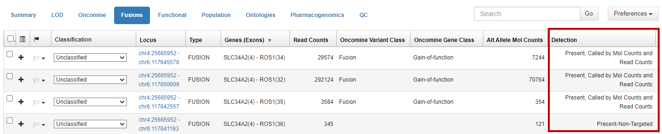
In Ion Reporter™ Software 5.16 and later, fusion calling in analysis workflows for Ion AmpliSeq™ HD and TagSeq panels and assays can be done by using either molecular (family) counts or read counts, and is based on the thresholds for each type of count for a specific fusion. When this parameter is set to True in the analysis workflow, the software calculates molecular counts and makes a Present call if the threshold value is met. If the threshold is not met, the software then calculates read counts to determine if the Present call can be made. Optionally, you can require the threshold value of both molecular count and read count metrics to be met to make a Present call, which is the case when the parameter is set to False. The parameter which controls the way a call is made is named “Use either family counts only or read counts only to make calls”. The type or types of counts used to make the call is displayed in the Detection column of the Analysis Results screen. The affect of this parameter, when turned on, is the potential for increased fusion call sensitivity. This parameter has no affect on NoCalls.
Other information that is reported for fusions includes the following:
-
The Locus column reports the start and end positions of the fusion transcript.
-
The Read Counts column reports the number of reads that provide evidence for the fusion call. For ASSAYS_5P_3P, read counts are displayed in the order 5', 3'.
-
The COSMIC/NCBI column provides links at which the fusion is described in these public Websites.
-
The variant ID column reports our identifier for the fusion variant (or assay or expression control). Each target in the Ion AmpliSeq™ panel has a unique variant ID.
An identifier contains information that is available in other fields in the results table.
Information
Description, example
Partner gene name
ALK
Gene and exon number
A13, for exon number 13 in the ALK gene
COSMIC ID, NCBI GenBank ID
COSF1198, AB374361
Non-Targeted
Appended to the Variant ID for fusion calls that are not targeted by the Ion AmpliSeq™ panel. Example: SLC34A2-ROS1.S4R35.Non-Targeted
Examples of Variant IDs for fusion calls (these examples are from demonstration data):
-
EML4-ALK.E6bA20.AB374362:
-
EML4: Donor gene
-
ALK: Partner gene
-
E6: Exon number 6 in the ELM gene ("E" for "ELM")
-
b: The second fusion (ordered by locus) with the same value in the Genes (Exons) column
-
A20: Exon number 20 in the ALK gene ("A" for "ALK")
-
AB374362: GenBank ID
-
-
SLC34A2-ROS1.S4R35.: Non-Targeted
-
SLC34A2: Donor gene
-
ROS1: Partner gene
-
S4: Exon number 4 in the SLC34A2 gene ("S" for "SLC34A2")
-
R35: Exon number 35 in the ROS1 gene ("R" for "ROS1")
-
Non-Targeted: Not included in the Ion AmpliSeq™ panel
-
-